


Furukawa HCR9-DS2 vs HCR900-DS / DS2: An Honest Buyer's Comparison
- admin

- 44 minutes ago
- 8 min read
Meta description: HCR9-DS2 or HCR900-DS/DS2? A neutral comparison of reliability, cost, performance, capability — and the weaknesses of each. From a Furukawa specialist since 1968.
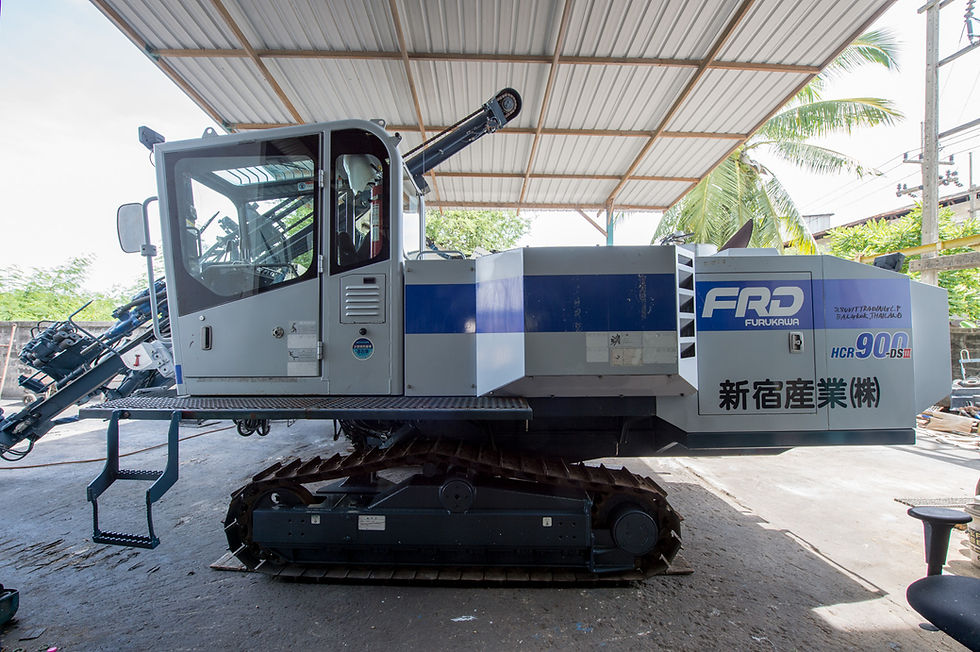
The short answer
These two machines are closer than most buyers expect. They are one generation apart; they share the same design philosophy, and in Thailand they sit only about ฿200,000–400,000 apart in price. This is not a "cheap machine versus good machine" decision.
Buy the HCR9-DS2 if you drill mostly T38 in soft-to-medium rock (limestone, weathered material), your holes are modest in diameter, and you want the lowest entry price, lower cost of maintenance, and full OEM parts availability. Overhaul Engine and drifter takes less than 7 days, except for severe damage.
However, its performance is limited not as powerful as the HCR900 Series. A poorly maintained machine may overheat easily. Used condition in the market typically requires extensive repairs due to its age.
Buy the HCR900-DS / DS2 if you work in hard or abrasive rock (granite, basalt, hard limestone), you want to run T45 with confidence, or you want a machine that will still be a sensible asset in ten years. The engine is so powerful and reliable, it hardly overheats during excessive usage.
However, it requires specialized and expensive services and maintenance. Tooks at least a month to overhaul the engine alone and requires skill technician to dig deep into its root cause.
The single biggest mistake buyers make is not choosing between these two. It is buying a -D or -ED machine by accident, because it looked the same in the listing. Read the next section before you read anything else.
The suffix matters more than the model number
Furukawa's suffixes are not decoration. They tell you what is behind the control panel, and that is the difference between a machine your fitter can fix in the quarry and one that sits idle waiting for a diagnostic laptop.
Suffix | What it means | Practical reality |
DS | Cabin with rod changer, minimal electronics (simple Omron-based control) | The one you want. Most popular in this region for a reason: it is repairable in the field. |
D | Cabin with rod changer, heavy electronics | Looks identical on paper to a DS. Far more difficult to keep running. Not popular. |
ED | Cabin with rod changer, extendable boom, high sensor count | Adds capability, adds a great many more things that can fail. Not popular. |
E- | Extension boom (used as a prefix on the above) | A capability option, not a control-system option. |
Side by side
HCR9-DS2 | HCR900-DS / DS2 | |
Generation | Previous | Current-era successor |
Drifter | HD609 | HD709 |
Class weight | 9.18 tonnes | 10.95 tonnes |
Typical build years in the market | ~1995–2004 | ~2005–2020 |
Rod / thread | T38 T45 (Not Recommend) | T38, T45 |
Hole range | ~64–76 mm | ~64–89 mm |
Dual Damper System (DDS) | Yes | Yes |
OEM drifter parts | Readily available | Readily available |
Typical Thailand price | ฿2.65M – ฿2.8M Good Working Condition | ฿2.9M – ฿3.4M Good Working Condition |
Capability: your rod system and your rock decide this
Ask two questions before you look at a single listing.
1. Are you running T38 or T45?
Both machines can be configured for either. The real question is whether the drifter has the impact energy to make T45 pay. The HD609 is at home on T38. The HD709 is a larger drifter on a heavier carrier, and it has meaningful headroom at T45 and at the larger end of the hole range. If your bench plan calls for T45 and bigger holes, the HCR9-DS2 will do it — but it will be working at the top of its range, and you will feel that in penetration rate and in consumables.
2. What rock are you actually in?
This is where the two machines separate, and it is not a small effect:
Soft to medium rock (most limestone, weathered formations): the gap narrows a lot. An HCR9-DS2 in good condition, running T38, will do honest work. The extra money for an HCR900 buys you less than the price difference suggests.
Hard and abrasive rock (granite, basalt, hard limestone): the gap opens. More impact energy and a heavier carrier mean faster penetration, straighter holes, and less punishment on drill steel.
If you drill one quarry with one rock type, this decision is simple. If you take contract work across different sites and cannot predict the rock, the HCR900-DS is the safer machine to own.
Performance
The HD709 carries Furukawa's Dual Damper System (DDS) — the feature Furukawa itself puts at the front of every HCR900 brochure. DDS keeps the bit held firmly against the rock throughout the blow, so more of the percussion energy goes into the rock and less comes back up the drill string as a reflected shock wave.
That matters for three things a quarry owner actually feels:
Penetration rate, especially as rock gets harder.
Hole deviation — straighter holes mean a blast pattern that behaves the way it was designed to.
Drill-steel life — bits, rods and shanks are a running cost every single month, and reflected shock waves are what destroy them.
Reliability
The good news applies to both machines: OEM drifter parts are readily available for the HD609 and the HD709. Neither of these is an orphan machine. This is worth saying plainly, because buyers assume a 20-year-old rig means a parts problem, and here it does not.
The reliability story is really the suffix story. A DS machine runs a minimal, largely hydraulic control system with simple Omron electronics. There is very little to go wrong that a competent fitter cannot diagnose on site. That is precisely why the DS variants held their value while the D and ED variants did not.
Where the two machines differ is age, not design:
Every HCR9-DS2 in the market is now twenty years old or more. Hoses, wiring looms, seals, cylinders and undercarriage wear out on a calendar, not just on an hour meter. A low-hour HCR9-DS2 is still an old machine. As a result, it is extremely rare to find a "Good Working" condition drill even from Japan, which is well known for its quality in the used market. The importer must put a lot of effort to repairs its back into working condition. A poorly maintained drill may suffer from overheating. This may result from wear-and-tear in the air compressor. (Can be check from heat radiating from the compressor itself) Another reason is the engine requires overhaul. However, overhauling the engine takes less than 10 days and below 100,000 THB (w/o severe damage), while overhauling the pump is widely available. For the drifter, parts are easily accessible.
The HCR900-DS / DS2 population spans roughly 2005 to 2020, so condition varies enormously. The model name tells you very little; the inspection tells you everything. The drill uses HEUI Injector(Hydraulically Actuated Electronic Unit Injector) which use specific oil to create very high pressure to atomize fuel and powerful output with low emission, unlike HCR9DS-2, which use proven/legacy direct injection, However, complexity in HEUI results in many ways, one, its requires very good care of engine oil, starts from the specification of the oil to oil cooler must be well maintained, not to pollute by water. Failure to do so will result in at least 250,000 THB to overhaul the injector alone. While the engine is highly reliable and suitable for heavy usage, its also need overhaul which costs around 300,000 - 400,000 THB and takes at least a month to finish.
[FILL: 2–3 specific things you actually see fail on each machine in your workshop. This is the most valuable content in the article and nothing on the internet has it.]
Weaknesses of the HCR9-DS2
Stated plainly, because you should hear them before you buy:
Overheating is common. Poorly maintained machine is widely available the market. Well maintained drill is very rare. Prices on the market may starts from 1.4M THB to 2.8 THB.
Age is unavoidable. The newest units are around 2004. There is no such thing as a young HCR9-DS2. Everything that ages on a calendar has aged.
Hour-meter rollover is common on rigs this old, and it is easy to be misled.
It is the smaller machine. Roughly 9 tonnes against 10.3. Less feed force and less impact energy, which you will feel in hard rock and at the larger end of the hole range. Overusage also results in overheating.
Less headroom on T45. It will not run on T45
Resale is limited. In five years you are selling a machine at 1.x M THB.
Weaknesses of the HCR900-DS / DS2
The newer machine is not free of problems either:
It costs more, and the higher marks cost a great deal more. A DSV can reach ฿4.8M. It is entirely possible to overpay.
It costs even more to maintain— The engine costs 400,000 THB to overhaul and a full month to service; production has to fully halt. The Injector also costs 250,000 THB for overhaul, replacing cost 400,000 THB.
Condition spread is enormous. DS, DS2, DS3 and DSV cover fifteen years of production. Two machines with the same badge can be worlds apart. Buying on the model name is a mistake.
Requires special care. starts from engine oil. Must use a specific type of oil and good-quality diesel. A poorly maintained filter may clog the injector and becomes a big story.
Who should buy which
HCR9-DS2 — small to medium quarry, one known rock type on the softer side, T38 work, tight capital budget, competent in-house fitter. You are accepting an old machine in exchange for a real saving, with your eyes open, while production is lower and require significantly lower maintainance cost.
HCR900-DS / DS2 — hard or variable rock, T45 work, contract drilling across sites, or you simply want the machine to still be worth something when you are finished with it. The extra ฿200,000–400,000 buys a newer machine with more power and better drill-steel economics.
Neither — if the only unit you can find is a -D or -ED. The discount will look attractive. It is not a discount; it is a deferred bill.
Frequently asked questions
Is the HCR900-DS just a renamed HCR9? No. It is the successor generation and a genuinely larger machine — a bigger better engine(CAT C7 vs ISUZU 6BG1), bigger chasis and a powerful drifter (HD609 vs HD709)
Is HCR9-DS2 the same as HCR9-DSII? Yes. Same machine, two spellings. The chassis plate uses DSII.
Can the HCR9-DS2 run T45? No
Are parts still available for a 20-year-old HCR9-DS2? Yes. OEM parts for the HD609 drifter are readily available. This is not an orphan machine.
Why do people warn against the ED series? Sensor count. The ED adds an extendable boom and a great deal more electronics. When it works it is capable; when it does not, it is difficult and expensive to bring back. In this region it is hard to sell even at a steep discount.
Which holds its value better? The HCR900-DSV or DS3, by a clear margin — it is younger, and DS-suffix machines hold value better than D and ED across the board.
About this comparison
S. Suvit Trading Ltd., Part. has imported, overhauled and serviced Furukawa hydraulic crawler rock drills since 1968. We sell both of the machines compared here. We have written this comparison to be useful rather than flattering, because a customer who buys the wrong machine is not a customer twice.
If you would like a specific unit assessed before you commit — hour-meter verification, drifter condition, control-system integrity — we are happy to look at it, including machines you are buying from someone else.
S. Suvit Trading Ltd., Part. 704 Charoen Rat Road, Khlong San, Bangkok 10600 suvit_trade@hotmail.com · +66 081 914 3688 · svtrade.com
Comments