


Furukawa HCR9 & HCR12 Engines: ISUZU 6BG1 / 6BG1T Deep Dive — Strengths, Weaknesses, Maintenance
- admin

- 5 days ago
- 7 min read
Updated: 3 days ago

Summary
At the heart of the HCR9 and HCR12 is the ISUZU 6BG1 / 6BG1T family — a 6.5-litre, six-cylinder, fully mechanical diesel that ISUZU has used across trucks, excavators and generator sets throughout Asia for more than 30 years. It is durable, simple, and everywhere.
For used-drill buyers in Thailand and Myanmar, this engine's greatest strength is what it does NOT have — no ECU, no common rail, no complex electronics. A workshop fitter can repair it on site, it tolerates low-quality fuel, parts are available everywhere, and above all downtime is low — a full overhaul is finished in days, at low cost.
HCR9 runs the 6BG1, naturally aspirated (no turbo)
HCR12 runs the 6BG1T, turbocharged, with more power and torque
Which engine is in which machine
Drill model | Engine | Configuration |
HCR9 (HCR9DS2) | ISUZU 6BG1 | 6-cylinder, no turbo |
HCR12 (HCR12-EDS, EDS2) | ISUZU 6BG1T | 6-cylinder, turbocharged Higher power/torque |
Note for buyers: In overseas markets, some HCR12 sub-variants were fitted with other engine brands (such as CAT). When buying an HCR12 from any source, always check the engine plate — just as you should read the model suffix (DS / D / ED) rather than the model name alone. Every HCR12 sold by S. Suvit Trading runs the ISUZU 6BG1T.
The real engine specifications
The figures below are verified against ISUZU specification documents and industrial-engine databases.
Item | 6BG1 (no turbo) | 6BG1T (turbo) |
Type | 4-stroke, inline 6-cylinder diesel, water-cooled, OHV | Same + turbocharger |
Displacement | 6.494 L (~6.5 L) | 6.494 L (~6.5 L) |
Bore × stroke | 105 × 125 mm | 105 × 125 mm |
Compression ratio | 17 : 1 | 17 : 1 |
Fuel injection | Direct injection, mechanical (no ECU) | Direct injection, mechanical + turbo (no common rail) |
Power (industrial rating) | ~114 hp (continuous) / ~129 hp (max) @ 2,500 rpm | ~163 hp @ 2,200 rpm (up to ~177 hp depending on tune) |
Max torque | ~424 N·m @ 1,500 rpm | ~554–600 N·m @ ~1,800 rpm |
Dry weight (engine only) | ~463 kg | ~490 kg |
Cylinder liners | Dry type, replaceable | Dry type, replaceable |
Key observation: The 6BG1 and 6BG1T share the same block, bore and stroke — the main differences are the turbo and tuning. That is why most internal parts interchange, and why maintenance on the two engines is so similar.
Strengths
1. Fully mechanical — field-repairable, no computer required
The 6BG1/6BG1T uses a mechanical injection pump — no ECU, no common rail, no army of sensors to fail. For quarry and remote drilling work this is the single biggest advantage: a competent fitter can diagnose and repair it with ordinary tools, with no diagnostic laptop and no waiting for a factory specialist.
It is the same principle that makes DS-suffix machines (minimal electronics) easier to sell and better at holding value than D and ED machines. A mechanical engine follows the same logic.
2. Low downtime — fast, cheap overhauls
This is the most tangible business advantage. If the block is not cracked, a full overhaul including pump and injector checks takes no more than 7 days, at a cost of roughly THB 100,000, with very cheap parts. The machine is back at work quickly, minimising lost production — unlike specialised or electronic engines, which take far longer and cost far more to repair.
3. Parts are everywhere, because dozens of machines share this engine
The 6BG1/6BG1T family is the same engine used in:
Hitachi excavators in the EX200 / ZX200 family (EX200-3, EX200-5, ZX200, ZX210, etc.) — machines seen all over Thailand
JCB excavators (JS200, JS240) and SANY (SY235)
ISUZU trucks in the FSR / FRR / NRR family
Generator sets such as Denyo and others
TCM forklifts and the Furukawa FL200-1 wheel loader
The result: overhaul kits, gaskets, pistons, liners, bearings and valves are easy to buy — genuine or good-quality aftermarket — at low prices across Thailand and the region.
4. Replaceable dry liners — cheaper overhauls
The engine uses replaceable dry cylinder liners. At overhaul time the liners are simply swapped out — no re-boring of the block — keeping overhaul cost low and turnaround fast.
5. Tolerates low-quality fuel
Mechanical direct injection tolerates inconsistent fuel quality far better than modern common-rail engines — a real advantage where diesel quality is unreliable, such as Myanmar job sites or remote quarries.
6. Cast-iron block and head — built to last
The cast-iron block and head are designed for sustained heavy work. With regular maintenance, this engine is famous for its endurance and long service life.
Weaknesses and limitations
Stated honestly, so customers can decide for themselves:
1. Old technology — more smoke, thirstier than modern engines
The 6BG1/6BG1T is an old design with no modern emissions control. It smokes more and burns more fuel than a modern common-rail engine of equal power. For the Thai and Myanmar markets this is rarely an issue — no strict emissions rules apply to drill rigs — but you should know it.
2. Lower power density than modern engines
From 6.5 litres it produces roughly 114–177 hp — modest by modern standards. In practice this means a big, heavy engine, traded for durability and simplicity.
3. The non-turbo 6BG1 can overheat under heavy load
The naturally aspirated 6BG1 tends to overheat when pushed hard or drilling very hard rock. Avoid overworking it — and if the hydraulic pump, air compressor or the engine itself is in poor condition, it will overheat immediately. The turbocharged 6BG1T, with its extra power, does not show this problem and is the better fit for heavy work and hard rock.
4. The turbo on the 6BG1T is one more wear item
The turbo version gives more power, but the turbo itself is one more component that wears — check turbo shaft play and oil leaks with particular care on high-hour engines.
5. These are old engines — hour-based wear is natural
Every HCR9 in the market is now 20+ years old, and ISUZU-engined HCR12s are no longer young. Wear parts — piston rings, liners, injectors, pumps, head gaskets — will all be due for attention. A low hour reading on an old machine is not always good news — old drill hour meters have usually rolled over (a 1998 machine showing 633 hours is almost certainly at 10,633).
Maintenance
Typical service intervals (industrial-engine reference values)
Use these as general guidance for this engine family; always defer to the Furukawa/ISUZU manuals and actual operating conditions:
Engine oil: Diesel-grade SAE 15W-40, CI-4 or higher. Change every ~500 operating hours; check the level weekly under heavy use.
Fuel filters: Replace on schedule; where fuel quality is poor, add a water/sediment separator ahead of the pump.
Cooling system: Use coolant with corrosion inhibitor; flush every ~2 years to prevent scale — critical in dusty, hot drilling work, especially on the heat-sensitive 6BG1.
Air filter: Inspect and clean/replace frequently in dusty environments (rock drilling is especially dusty). A clogged filter costs power and adds soot.
Valve clearance: Check and adjust on schedule. Wrong clearance means noise, poor combustion and valve damage.
Fan/alternator belts: Check tension regularly.
Failures we actually see in the workshop
From our own experience repairing and overhauling 6BG1/6BG1T engines, the most common symptoms are:
Overheating — usually poor cooling-system maintenance (radiator, coolant, water pump). The non-turbo 6BG1 is especially heat-sensitive under heavy load or in hard rock.
Blow-by (combustion gas leaking past the rings) — look for smoke pushing out of the breather tube under the engine — the classic sign that rings/liners are wearing.
Thick black smoke — usually a worn-out engine (major internal wear) or degraded injectors/pump.
Overhaul work and cost
If the block is not cracked, a full overhaul with pump and injector checks takes no more than 7 days and costs roughly THB 100,000. With cheap parts and replaceable dry liners (no re-boring), overhaul cost stays low and the machine is back at work fast.
Before you buy: engine and control-system checks
If you are considering a used HCR9 or HCR12, check at least the following:
Exhaust smoke colour — heavy black smoke under load points to worn injectors/pump or a blocked air filter; white/blue smoke points to oil burning (rings/liners).
Smoke from the breather tube underneath — strong smoke while the engine runs means blow-by; rings/liners are already worn.
Oil pressure — abnormally low pressure indicates internal wear.
Running temperature — especially on the 6BG1: watch the temperature under sustained load, and inspect the radiator and coolant.
Turbo (6BG1T only) — check shaft play and oil traces in the piping.
Hour meter vs. actual condition — an implausibly low reading on an old machine usually means the meter has rolled over. Always judge by physical wear.
Drill control system (Omron DCU) must be complete and original — this article focuses on the engine, but the other critical checkpoint on any HCR is the Omron-based drill control unit and its many sensors. Some importers cut these sensors out for convenience and never restore the system to original, leaving the machine below full capability and hard to fix later. Verify the control system is complete before you commit.
Frequently asked questions
Which engines do the HCR9 and HCR12 use? The HCR9 runs the ISUZU 6BG1 (6-cylinder, no turbo); the HCR12 runs the 6BG1T (turbocharged). Some overseas HCR12 sub-variants used CAT engines — always check the engine plate.
What is the difference between the 6BG1 and 6BG1T? Same block, same 6.5-litre displacement. The 6BG1T adds a turbo for more power and torque; most internal parts interchange.
Does the 6BG1 really overheat easily? The non-turbo 6BG1 tends to run hot under heavy load or in very hard rock — especially if the cooling system, hydraulic pump or air compressor is in poor shape. Maintain the cooling system and avoid overworking it. The turbocharged 6BG1T does not show this problem.
Are parts still easy to find for a 20-year-old engine? Very easy — it is the same engine as in Hitachi EX/ZX200 excavators, ISUZU trucks, generator sets and many other machines, with both genuine and good-quality aftermarket parts available.
Is a 6BG1 overhaul slow or expensive? If the block is not cracked, an overhaul with pump/injector checks takes no more than 7 days and roughly THB 100,000 — cheap parts, replaceable dry liners, no re-boring. Downtime stays low.
Does this engine have complex electronics? The engine itself is fully mechanical — no ECU, no common rail. The machine, however, has an Omron drill-control system with sensors; verify it is complete and original, not cut out.
About this article
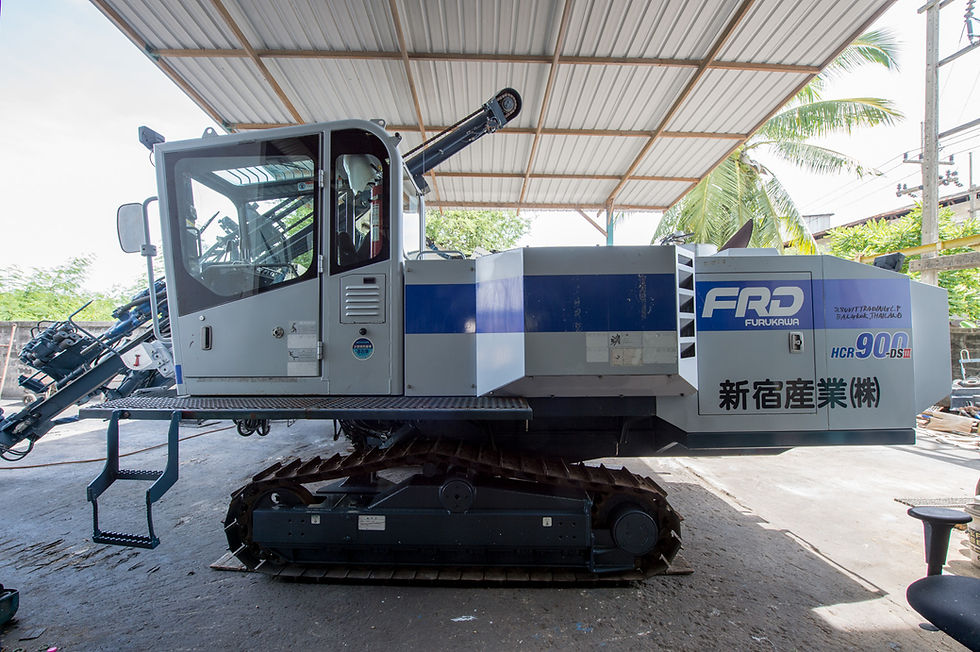
S. Suvit Trading Ltd., Part. has imported, overhauled and serviced Furukawa hydraulic crawler drills since 1968. We sell Furukawa HCR9, HCR12, HCR900 and other models, with engine repair, overhauls, OEM parts, and restoration of Omron control systems to original.
If you would like a machine or engine assessed before you buy — including one you are buying from someone else — we are happy to inspect it.
S. Suvit Trading Ltd., Part. 704 Charoen Rat Road, Khlong San, Bangkok 10600 suvit_trade@hotmail.com · +66 081 914 3688 · svtrade.com
Comments