


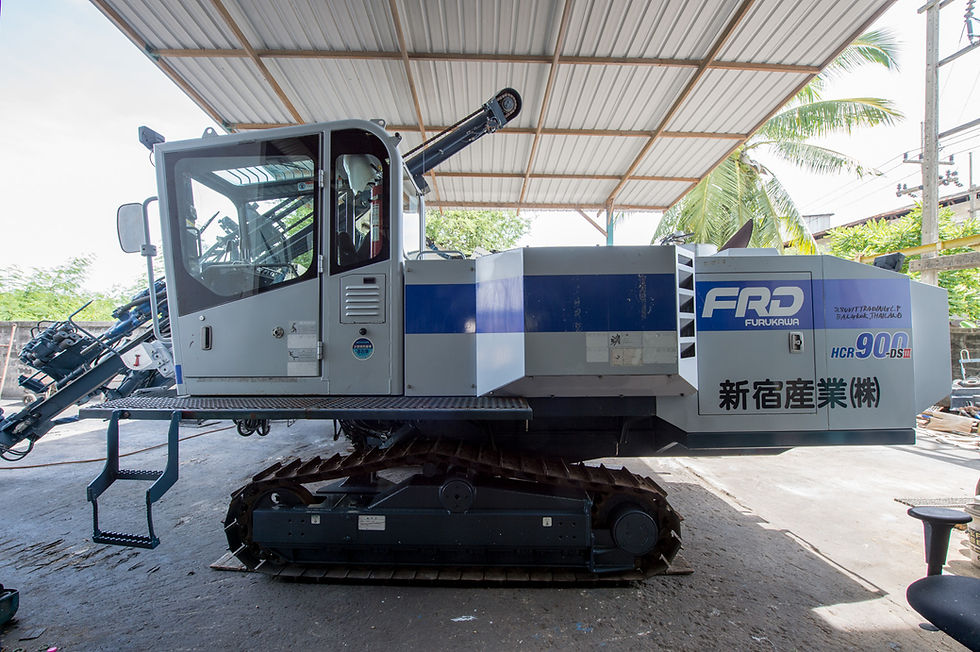
Compare Furukawa HCR900-DS vs HCR900-DS2 with In-depth comparison CAT C7 vs CAT3126B
- admin

- 9 hours ago
- 5 min read
A comparison for used Furukawa drill buyers — by S. Suvit Trading, Furukawa specialist since 1968

Quick summary
The HCR900-DS and HCR900-DS2 are nearly the same machine — they differ mainly in the engine. The drifter, boom, guide shell, rod changer, drilling control system, and chassis are all identical.
HCR900-DS uses the CAT 3126B (176 hp) engine
HCR900-DS2 uses the CAT C7 (225 hp) engine — the direct successor to the 3126B
How to choose: Both engines come from the same family and use the same injection system (HEUI). The DS2 is more powerful and newer, but maintenance history matters more than the model number — a well-cared-for DS can beat a neglected DS2.
1. What's the same, what's different

Many people assume DS and DS2 are different models. In reality, the "2" simply means an updated version with a newer engine — the machine structure is almost entirely the same.
Identical: HD709 drifter, JF200 boom, GH831 guide shell, GR180 rod changer (4 rods), hydraulic drilling control system, Pentagonal chassis, PDS265 compressor, 65–90 mm hole range.
Different: the engine (3126B → C7) and the engine-speed modes — which is the heart of this article.
What this means for the buyer: almost all wear parts — the HD709 drifter seal kits, undercarriage parts, rod changer components, filters — are interchangeable between the DS and DS2. That's a real advantage if you run both in one fleet.
2. The engine — where the real difference lies

Both engines are CAT 7.2-litre inline 6-cylinder units from the same family — the C7 is the engine CAT developed directly from the 3126B in 2003, not a different line.
Item | CAT 3126B (HCR900-DS) | CAT C7 (HCR900-DS2) |
Power in the drill | 176 hp (131 kW @ 2,200 rpm) | 225 hp (168 kW @ 2,200 rpm) |
Torque (typical range) | 420–860 lb-ft | 520–925 lb-ft |
Fuel system | HEUI | HEUI (updated) |
Connecting rods | Forged steel | Powdered metal, fractured cap |
Emissions standard | Tier II | Tier III |
Production years | 1998–2004 | 2003–2009 |
What the C7 improved over the 3126B: roughly 49 more horsepower (about +28%), larger water and oil pumps (better cooling), a more robust front gear train, and a faster ECM with ACERT technology.
The most important shared trait: both use HEUI
HEUI is an injection system that uses engine-oil pressure to actuate the injectors instead of a mechanical high-pressure pump. The consequence — which every owner of either model must understand:
Engine oil is the heart of the injection system — not just a lubricant, but the direct "driver" of the injectors. Use only CAT-spec engine oil Never extend the oil-change interval — this is the number-one cause of HEUI failure Dirty or degraded oil → damaged HEUI pump and injectors
Mechanics in the field agree on this point: a well-maintained HEUI engine runs a long time, but a neglected one becomes hard and expensive to repair.
3. Weaknesses of the CAT 3126B (in the HCR900-DS)
Strengths
Parts are easier to find and cheaper — extremely common in trucks, buses, and equipment worldwide
Forged-steel connecting rods — generally stronger than the C7's powdered-metal rods
Well understood by mechanics in Thailand and the region
With low-rpm, well-maintained use, over 20,000 hours has been reported
Weaknesses / common problems
Problem | Symptom |
HEUI pump failure | Power loss, hard starting, rough running (the number-one issue) |
Injector failure/leakage | Black smoke, oil consumption, power loss, oil crossing into the fuel |
Injector synchronization | ⚠️ Requires a dial gauge and special tooling after any injector work; wrong setting causes knock/misfire |
High-pressure oil line / crossover tube cracks | Oil leaks, pressure drop (seen on early units) |
Low oil pressure / coolant leaks | Warning lights, overheating |
Note: although it's the older engine, the 3126B is not a purely mechanical engine — it still needs CAT ET to read fault codes, unlike the ISUZU 6BG1 in the HCR9, which can be serviced with ordinary tools.
4. Weaknesses of the CAT C7 (in the HCR900-DS2)
Strengths
About 28% more power — drills hard rock and sustains continuous work more comfortably
Better cooling by design (larger water and oil pumps)
Stronger front gear train
Younger engine, more remaining service life, better resale value
Weaknesses / common problems
Problem | Symptom / note |
Overheating under sustained heavy load | Reports that the cooling fan engages later than ideal — watch the radiator carefully |
Injector failure / misfire | Rough running, smoke, oil consumption (inherited from the HEUI family) |
Never overfill the engine oil | ⚠️ Causes excessive blow-by — fill toward the lower end of the range |
CAT filters only | Oil and fuel filters must be to spec |
More complex electronics | Harder to diagnose; requires CAT ET |
On connecting rods — what most sellers won't tell you The C7 uses powdered-metal, fractured-cap connecting rods, while the 3126B uses forged-steel rods, generally considered stronger. In practice this is not a problem if the engine is run within rating and well maintained, but it's why some mechanics still prefer the 3126B — and a caution against any idea of "tuning for more power," which should not be done in a drill rig.
5. Engine-speed modes — a difference you can feel
Per the HCR900-DS2 factory spec sheet, it has a two-level engine-speed selector:
Normal mode: 2,200 rpm
Eco mode: 2,000 rpm
Eco mode reduces fuel use and noise on lighter work, while the auto-throttle raises rpm automatically when drilling/flushing begins and returns to idle on its own when the load clears — making the DS2 more economical and quieter overall.
6. Which one should you buy?
Choose the HCR900-DS (CAT 3126B) when:
Budget is tight and you want the lower entry price
You drill soft-to-medium rock, not heavy continuous work
You want engine parts that are easier and cheaper to source
You value the forged-steel connecting rods
Choose the HCR900-DS2 (CAT C7) when:
You drill hard rock or work continuously and want power in reserve
You want a younger engine with more remaining life
Resale value matters to you
You want the fuel-saving eco mode
Pre-purchase checks (apply to both, since both use HEUI)
Oil-change history — most important, because the oil drives the injectors; be wary if there are no records
Exhaust smoke — heavy black indicates worn injectors/HEUI pump; white-blue indicates oil consumption
Engine oil pressure — abnormally low directly affects the HEUI system
Blow-by — open the oil filler while running; heavy smoke pushed out means worn rings/liners
Cooling system — radiator, scale, coolant condition (especially important on the C7)
Read codes with CAT ET — required on both; have the seller show you
Hour meter vs. actual condition — implausibly low hours on an old machine often means the meter has rolled over
7. Conclusion
The HCR900-DS and HCR900-DS2 are the same machine differing mainly in the engine — the HD709 drifter, boom, guide shell, rod changer, drilling control, and chassis are all identical, so most wear parts interchange.
On the engine: the C7 is the direct successor to the 3126B — more powerful (225 vs 176 hp) and better-cooled, but with powdered-metal rods and more complex electronics.
What matters more than the model: both engines use HEUI, which relies on engine oil to drive the injectors. So maintenance history matters more than the model number — a DS2 whose oil changes were neglected can be worse than a well-maintained DS.
About this article
S. Suvit Trading Ltd., Part. has imported, overhauled, and serviced Furukawa hydraulic crawler rock drills since 1968. We sell Furukawa drills including the HCR900, HCR1000, and other models, with repair, genuine parts, and restoration of the control system back to original.
We write comparisons like this to be useful rather than flattering — including the weaknesses of both models — because a customer who buys the wrong machine does not come back.
If you'd like a machine assessed before you commit — including one you're buying from someone else — we're glad to inspect it.
S. Suvit Trading Ltd., Part. 704 Charoen Rat Road, Khlong San, Bangkok 10600 svtrade.com


Comments